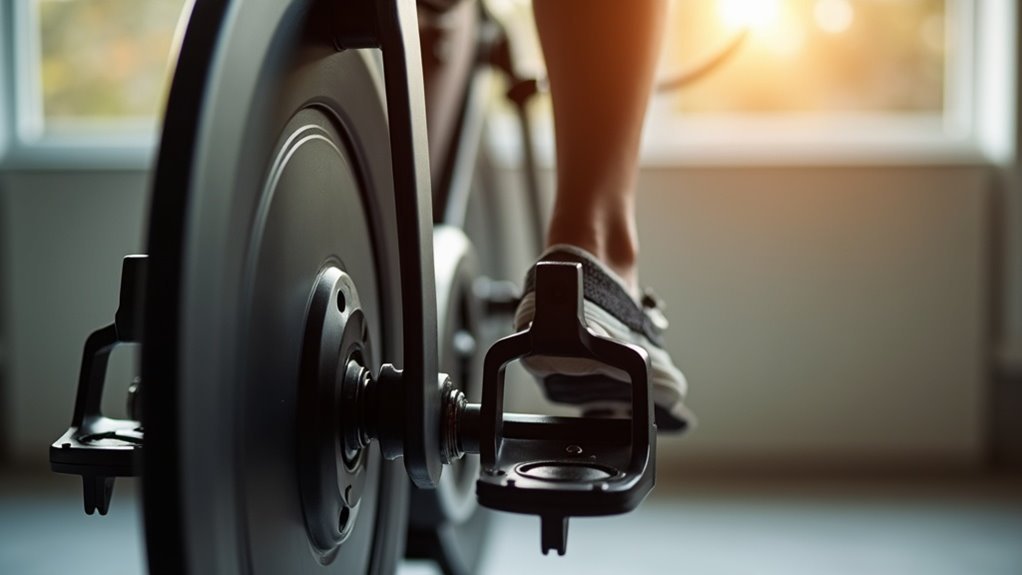
The most natural Q-Factor range for spin bikes is between 140mm and 170mm. Staying within this range ensures optimal leg positioning, enhancing both comfort and power transfer during your home workouts. If your Q-Factor is too wide or narrow, it can lead to joint pain and inefficiency, making your exercise routine less effective. Even small adjustments of just 5-10mm can significantly improve your cycling experience. In the next section, we’ll explore how to measure and modify your Q-Factor for better performance and comfort, helping you achieve your fitness goals at home.
Key Takeaways
- A Q-Factor between 140mm and 170mm typically feels most comfortable for home fitness enthusiasts during their spin workouts.
- Narrow Q-Factors can lead to joint discomfort, while wider Q-Factors may cause issues that affect your overall performance.
- Ensuring proper leg alignment is essential; an optimized Q-Factor mimics your natural body movement, enhancing comfort during your at-home cycling sessions.
- Making adjustments of 5-10mm can greatly improve the ergonomic fit of your spin bike, resulting in a better overall cycling experience.
- Consulting a bike fitter can provide valuable, personalized insights to help you achieve the most natural Q-Factor range for your home gym setup.
Understanding Q-Factor
When you hop on a spin bike for your home workouts, understanding the Q-Factor is essential for maximizing your comfort and efficiency.
The Q-Factor refers to the lateral distance between the pedal attachment points on the crank, and it’s crucial for proper leg positioning. A well-aligned Q-Factor mimics your body’s natural movement, ensuring that your foot position feels just right during those intense cycling sessions.
If the Q-Factor is too wide, exceeding 210mm, it can lead to joint pain and diminish your power transfer, impacting your overall performance.
Always check the product specifications for Q-Factor values to select a spin bike that fits you perfectly, promoting optimal comfort and effectiveness in your home fitness routine.
Ideal Q-Factor Ranges
Finding the ideal Q-Factor range is essential for ensuring your home spin bike workouts are both comfortable and efficient.
Most riders, regardless of gender, benefit from a Q-Factor between 140mm and 170mm, providing optimal comfort and effective power transfer. A narrower Q-Factor can lead to joint pain and inefficient leg positioning, while a wider range may cause discomfort, particularly for more serious riders.
Most riders find optimal comfort and power transfer with a Q-Factor of 140mm to 170mm, avoiding joint pain and inefficiencies.
Staying within the recommended range helps prevent inward foot positioning, enhancing your overall exercise experience at home.
Quality spin bikes designed for home use take these ideal Q-Factor ranges into account, aligning with human anatomy to maximize performance and minimize discomfort during your workouts, helping both men and women achieve their fitness goals.
How Q-Factor Impacts Comfort
The Q-Factor significantly affects your stance width, which is crucial for maintaining proper knee alignment and overall comfort during home workouts.
If your Q-Factor isn’t optimized, you may encounter discomfort or even pain during your exercise routines.
Adjusting your Q-Factor to find the right fit is essential and can greatly improve your home gym experience, making your workouts more enjoyable and effective for both men and women.
Optimal Stance Width
Optimal stance width is crucial for your comfort and efficiency while using a spin bike, with the Q-Factor being a significant element in achieving that balance.
For most home fitness enthusiasts, the ideal Q-Factor range falls between 140mm and 170mm. A narrower Q-Factor around 140mm tends to align more closely with your natural body movement, helping to minimize the risk of joint pain during your workouts.
Conversely, a wider Q-Factor (170mm to 210mm) may result in discomfort and inefficiency, especially for more serious cyclists.
Knee Alignment Importance
When your knees align properly with your ankles while using home gym equipment, you significantly enhance your comfort and workout efficiency. A narrow Q-Factor, typically between 140mm to 170mm, promotes optimal knee alignment, reducing the risk of joint pain during exercises. Testing various Q-Factor settings helps you find your ideal stance width, ensuring that your equipment aligns with your natural leg positioning.
| Q-Factor Range | Impact on Knee Alignment |
|---|---|
| 140mm – 170mm | Improved comfort |
| 170mm – 200mm | Possible discomfort |
| 200mm+ | Increased injury risk |
Finding your perfect Q-Factor is essential for staying healthy and comfortable while exercising at home.
Personal Comfort Preferences
Finding the right Q-Factor on your spin bike can greatly enhance your comfort during home workouts, as individual preferences vary based on anatomy and riding style.
A narrower Q-Factor often mimics natural body movement, promoting personal comfort and efficiency while pedaling, which is especially important for those exercising at home.
If you have wider hips, a larger Q-Factor might help alleviate knee discomfort and improve alignment, making your at-home cycling sessions more enjoyable.
Adjusting the Q-Factor within a 5-10mm range can lead to significant comfort improvements, particularly for those with previous knee issues.
Ultimately, selecting a spin bike that aligns with your anatomical dimensions is essential for preventing joint pain and ensuring a satisfying and effective home exercise experience.
Measuring Q-Factor Accurately
To ensure your spin bike’s Q-Factor is measured accurately, begin by positioning the crank arms parallel to the bike’s seat tube. Measure the distance from the center of the seat tube to the outer edge of one crank arm, then double that distance to account for both sides.
This Q-Factor measurement is crucial for maintaining proper leg alignment and enhancing comfort during your workouts. An incorrect Q-Factor can lead to joint pain and inefficient power transfer, which can hinder your fitness goals.
Always refer to the manufacturer specifications, as these values can differ significantly across bike models. If you’re unsure, don’t hesitate to reach out for precise Q-Factor details specific to your bike, ensuring you get the most out of your home gym experience.
Modifying Q-Factor for Better Fit
Adjusting the Q-Factor on your spin bike can significantly improve your home workout experience, especially if you’re experiencing discomfort or strain.
By using pedal extenders, you can increase the distance between the pedals, enhancing your comfort during rides. While it’s more challenging to narrow the Q-Factor, you can adjust your cleat positions and choose longer pedal spindles to ensure proper alignment.
Using pedal extenders can boost your comfort by widening the pedal distance, while adjusting cleat positions helps refine alignment.
Experimenting with minor adjustments, typically within 5-10 mm, can greatly enhance your ergonomic fit and minimize knee strain.
For optimal cycling performance and comfort, aim for a Q-Factor between 140mm and 170mm as you work towards achieving your fitness goals at home.
Performance Benefits of Q-Factor
When exploring the performance benefits of Q-Factor in your home gym setup, you’ll find that its ideal range can significantly enhance your cycling efficiency.
A Q-Factor between 140mm and 170mm promotes optimal leg positioning, improving pedaling efficiency and reducing knee discomfort.
For those who prefer wider Q-Factors, they can offer enhanced stability and riding comfort, making them especially beneficial for larger riders.
Even subtle adjustments within a 5-10 mm range can greatly impact your experience on spin bikes, allowing you to customize your workout without the need for major equipment changes.
Choosing the Right Spin Bike Q-Factor
Finding the right Q-Factor for your spin bike is crucial for enhancing your home workout experience.
For optimal performance and comfort, aim for a Q-Factor between 140mm and 170mm. This range promotes efficient pedaling and helps you maintain proper leg alignment, which can lead to better power transfer and reduced joint discomfort.
A narrower Q-Factor, such as the 140mm found on the Wahoo Kickr, can significantly improve your positioning while you ride. Conversely, going below 140mm may misalign your body mechanics, resulting in discomfort, while exceeding 210mm is generally considered inefficient.
Personalizing Your Cycling Experience
To personalize your home workout experience, start by understanding your body’s unique fitness needs.
Experimenting with your exercise equipment, like adjustable weights or resistance bands, can help you find that ideal setup for comfort and efficiency.
Pay attention to your posture while performing exercises, as it provides valuable insights into the adjustments that work best for your body alignment and overall performance.
Understanding Your Body’s Needs
Understanding your body’s unique needs is crucial for enhancing your home cycling experience on a spin bike. The Q factor plays a significant role in your comfort and overall performance. A narrow Q-Factor may lead to joint discomfort, while a wider Q-Factor is more accommodating for those with broader hips, ultimately improving your ride.
It’s important to consider the distance between your feet, as personal comfort can vary greatly based on individual body dimensions. Here are some key takeaways for optimizing your at-home workouts:
- Joint pain can hinder your fitness progress.
- Prioritizing personal comfort can increase your workout motivation.
- The right Q factor enhances cycling efficiency.
- Adjusting the pedals allows for a customized fit.
- Discovering your ideal range can revolutionize your cycling sessions at home.
Investing the time in these adjustments will significantly enhance your home workout experience.
Experimenting With Adjustments
As you dive into personalizing your home cycling experience, experimenting with adjustments on your spin bike can lead to significant improvements in both comfort and performance.
Pay special attention to pedal placement, as even small changes of 5-10 mm can greatly enhance your cycling efficiency. If you find your Q-factor too narrow, consider using pedal extenders for a wider stance, particularly beneficial for those with broader hips.
Always keep an eye on how these adjustments impact your knee alignment and overall pedaling mechanics to prevent discomfort.
For the best results, consulting a bike fitter can offer tailored insights to optimize your setup, ensuring you achieve the ideal balance between comfort and efficiency in your home workouts.
Optimal Fit for Comfort
Finding the right fit on your spin bike can significantly enhance your home workout experience, making it both comfortable and effective. To achieve the ideal fit, it’s important to consider your Q-factor. A narrow Q-factor of around 140mm aligns well with human anatomy, improving leg positioning and helping to minimize joint pain.
While some individuals may prefer a wider Q-factor, this can sometimes lead to discomfort during more intense sessions. Personal assessment is essential; everyone’s anatomy and preferences differ, so it’s crucial to discover what feels most natural for you.
- Prevent joint pain
- Enhance cycling efficiency
- Improve overall comfort
- Boost workout enjoyment
- Achieve better performance
Investing time in finding the right fit won’t only elevate your cycling experience but also support your journey toward a healthier lifestyle from the comfort of your home gym.