Kettlebell shapes play a crucial role in determining swing trajectory, which in turn affects the efficiency and stability of your home workouts. A kettlebell with a lower center of mass enhances balance, allowing for smoother swings that are essential for effective training. On the other hand, unevenly shaped kettlebells can throw off your swing path, leading to instability and increasing the risk of injury. Kettlebells with wider bases provide improved stability, while the design of the handle can significantly influence your grip and control during exercises. By understanding these design elements, you can optimize your performance and get the most out of your at-home fitness routine. There’s a lot more to discover about how kettlebell design can shape your training experience and contribute to your overall health.
Key Takeaways
- The shape of a kettlebell plays a crucial role in influencing swing trajectory, which is essential for effective home workouts. Kettlebells with a lower center of mass promote smoother swings and better stability, making them ideal for both men and women looking to enhance their exercise routines at home.
- Kettlebells with rounded bottoms allow users to achieve higher swings without losing balance, enhancing the fluidity of the movement and making workouts more enjoyable and effective.
- Kettlebells with wider bases offer improved stability during swings, ensuring that individuals can perform exercises confidently, while narrower designs may complicate swing dynamics and control, especially for those new to kettlebell training.
- Unevenly shaped kettlebells can disrupt swing trajectories, increasing the risk of injury and requiring greater core engagement for stabilization, which can be challenging for home exercisers.
- Additionally, the proper handle positioning and thickness of kettlebells are vital for grip strength, directly influencing overall swing performance and trajectory control, making it important to choose the right kettlebell for your home gym setup.
The Design of Traditional Kettlebells
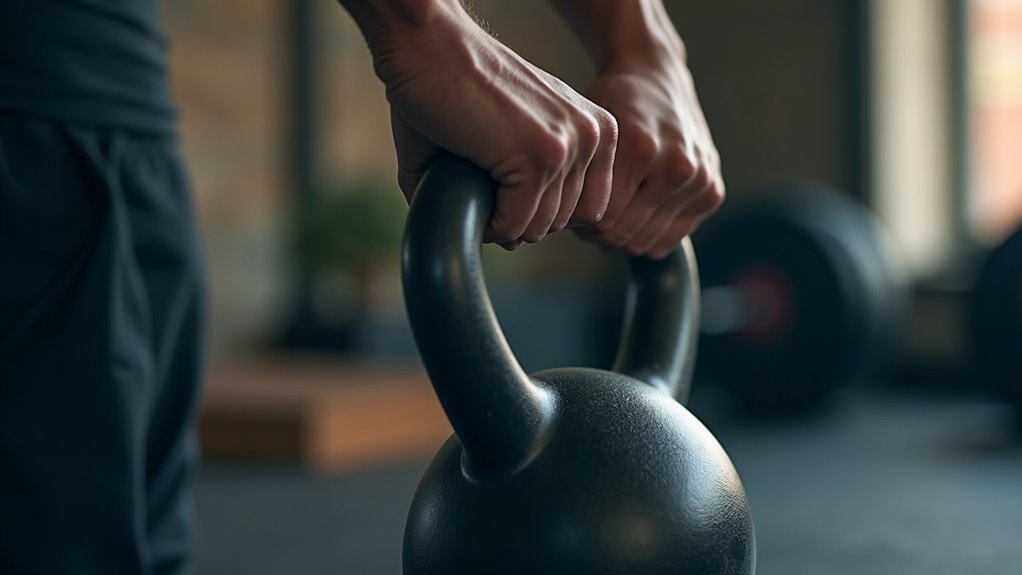
When you consider the design of traditional kettlebells for your home gym, their unique shape plays an essential role in optimizing your workout performance. The rounded bottom and strategically placed handle facilitate a natural swing trajectory during kettlebell swings, making them perfect for at-home exercise routines.
With the center of mass positioned below the handle, you can maintain balance and control throughout each movement, which is crucial for effective home workouts.
The kettlebell’s center of mass below the handle enhances balance and control for effective home workouts.
The handle’s width and height are specifically optimized for grip and leverage, allowing you to generate power effectively from your hips and legs, whether you’re a beginner or more advanced in your fitness journey.
Unlike dumbbells, the asymmetrical design of kettlebells promotes a hip hinge movement, ensuring proper form and maximizing the benefits of your exercises while accommodating various swing variations safely and dynamically.
This versatility makes kettlebells an excellent addition to any home gym, helping both men and women achieve their fitness goals.
Impact of Kettlebell Shape on Trajectory
The design features of a kettlebell, including handle positioning and base width, significantly influence swing path dynamics, making them an essential part of your home gym equipment.
Opting for a kettlebell with a lower center of gravity results in improved stability, which contributes to a smoother swing trajectory.
Kettlebell Design Features
While kettlebell design may appear to be a minor aspect, it significantly impacts your ability to control the swing trajectory during your home workouts.
Key design features, such as a wider base and a distinct bell shape, enhance stability, leading to a smoother swing experience. The thickness and positioning of the handle are crucial for your grip and control, which directly affect how you lift and swing the kettlebell.
Compact designs allow for quicker transitions and vertical paths, enhancing explosiveness in exercises like the snatch—ideal for maximizing your home fitness routine.
Additionally, variations in weight distribution, particularly with flatter profiles, can change momentum and swing dynamics, requiring different techniques to maintain proper form.
This makes understanding kettlebell design essential for both men and women looking to achieve their fitness goals at home.
Swing Path Dynamics
Understanding how kettlebell shape affects swing path dynamics is essential for optimizing your home workouts. The design of the kettlebell influences its center of mass, significantly altering how it behaves during swings.
Wider bases create stable swings, making them ideal for both beginners and seasoned fitness enthusiasts, while narrower designs may lead to unpredictability, which could complicate your routine. The curvature of the kettlebell bell also plays a key role; pronounced curves allow for higher swings without sacrificing balance, ensuring you can push your limits safely.
If you’re using a kettlebell with a thicker handle, you’ll need increased grip strength, which can change your swing dynamics as you adapt to maintain control. This is especially important for home workouts, where maintaining form is crucial to prevent injury.
Furthermore, weight distribution is vital in generating momentum, affecting how easily you achieve the desired height during each repetition. By focusing on these elements, you can enhance your performance and make the most of your home gym experience.
Importance of Center of Mass in Kettlebell Swings
When selecting a kettlebell for swings in your home gym, understanding the center of mass is crucial, as it significantly impacts the stability and control of your movements.
Traditional kettlebell designs typically feature a lower center of mass, which promotes smoother swing trajectories and enhances your overall control. Conversely, kettlebells with a higher center of mass can disrupt stability, making the swing more challenging.
This knowledge allows you to choose the right kettlebell shape that aligns with your fitness goals, ultimately influencing your grip and swing technique.
Effects of Unevenly Shaped Kettlebells
When exercising with kettlebells at home, the shape of the bell can significantly impact your training experience, particularly with unevenly shaped kettlebells.
These kettlebells can disrupt swing trajectories, leading to balance and control challenges. The uneven weight distribution may cause unexpected pulls, making it harder to maintain proper form, especially during hip hinge movements.
Uneven kettlebells can disrupt swing trajectories, creating balance challenges and making it difficult to maintain proper form during exercises.
This instability can heighten the risk of injury to your lower back due to unpredictable forces acting on your spine. Moreover, you may find yourself needing to engage your core more actively to stabilize your body, which could reduce the overall effectiveness of your workout.
For a safer and more efficient home gym experience, consider using evenly shaped kettlebells to enhance your training and achieve better results.
Fluid Motion and Engagement of the Posterior Chain
The design of the kettlebell plays a crucial role in your swing trajectory and overall movement efficiency, especially when working out at home.
A well-crafted kettlebell can enhance the fluidity of your exercises, allowing you to effectively engage your posterior chain, which includes your glutes and hamstrings.
Kettlebell Shape Impact
Understanding how kettlebell shape impacts fluid motion and the engagement of the posterior chain is essential for optimizing your home workout routine. The design of the kettlebell influences weight distribution, which affects swing trajectory and movement mechanics—crucial for achieving effective results from your exercises.
A wider handle promotes stability, enhancing control and facilitating fluid motion during your swings, critical for proper engagement of your posterior chain. Additionally, kettlebells with rounded bottoms create a smoother arc, improving the transfer of kinetic energy from your hips, making your workouts more efficient.
Compact designs allow for quicker transitions and better timing, which can enhance your overall performance. Variations, such as traditional versus competition models, also affect biomechanics; competition kettlebells provide consistency across different weights, making them a great choice for your home gym setup.
Embrace these insights to elevate your fitness journey at home!
Swing Trajectory Dynamics
To maximize the effectiveness of your kettlebell swings at home, it’s crucial to understand how swing trajectory dynamics interact with fluid motion and the engagement of your posterior chain.
The design of the kettlebell significantly influences weight shifts, which subsequently affect your swing path. A wider handle allows for smoother transitions, giving you better control during your workout.
Kettlebells with pronounced bell shapes enhance the downward pull, optimizing activation of the posterior chain for powerful hip extensions—key for building strength and endurance in your home gym routine.
Furthermore, the base angle of the kettlebell plays a role in stability; a flatter base supports consistent motion, while a rounded base requires more control, making your workout more challenging.
Therefore, choosing the right kettlebell design is essential for effective engagement of your posterior chain and achieving your fitness goals from the comfort of your home.
Enhanced Posterior Chain Activation
Swinging a kettlebell effectively at home relies on properly activating your posterior chain, which can be influenced by the kettlebell’s shape and design.
Opting for a bottom-heavy kettlebell promotes smooth motion, enhancing momentum transfer and engaging your glutes and hamstrings more effectively.
Additionally, wider handles allow for a comfortable grip, improving control during your kettlebell swings.
Spherical designs support consistent movement trajectories, optimizing hip hinge mechanics and maximizing the recruitment of your posterior chain.
Furthermore, variations in shape can shift the center of gravity, demanding increased stabilization and power from your posterior chain, ensuring a safer and more effective workout right in your home gym.
Safety Considerations for Kettlebell Swing Form
Proper form during kettlebell swings is essential for preventing injuries, especially for those exercising at home. Emphasizing the hip hinge movement instead of relying on the arms or shoulders for power is crucial.
Here are some key safety considerations to keep in mind:
- Maintain a neutral spine to avoid lower back strain, ensuring a safe workout environment.
- Ensure a controlled kettlebell path to prevent erratic movements that could lead to injury.
- Avoid abrupt stops or jerking motions during swings to promote smooth, effective movements.
- Engage your core and glutes for stability, which is vital for maintaining balance while exercising at home.
- Practice techniques such as shoulder retraction and proper knee bend to enhance your form and reduce the risk of injury.
Enhancing Efficiency Through Proper Kettlebell Design
When selecting a kettlebell for your home gym, it’s essential to understand how its design impacts your workout efficiency. The shape and weight distribution of a kettlebell significantly influence your swing performance by altering the center of gravity.
A wider base enhances stability, allowing for smoother swings, while a narrower base can offer a dynamic challenge for those looking to push their limits.
The height and width of the handle also play crucial roles; a higher handle minimizes wrist strain, which helps improve grip and overall efficiency during your workouts.
Additionally, rounder kettlebell shapes promote fluid swing paths, reducing unwanted rotational forces that can compromise your form.
Finally, the material and finish of the kettlebell affect grip comfort, which is vital for maintaining proper form throughout your swings, ensuring you can work out effectively and safely at home.
Recommendations for Selecting Kettlebells
Selecting the right kettlebells is crucial for maximizing your home workout experience, as their design significantly impacts both your performance and safety.
Choosing the right kettlebells is essential for enhancing your workout performance and ensuring safety at home.
Here are some tailored recommendations for choosing kettlebells that suit your home gym needs:
- Opt for traditional kettlebell designs featuring wider handles and stable bases to ensure a comfortable grip and balanced movements.
- Look for a bell shape that facilitates a smooth swing trajectory, enhancing your workout efficiency.
- Ensure that the kettlebells have a flat bottom for added stability, making them safer and easier to store.
- Begin with lighter, compact kettlebells to help you perfect your form before progressing to heavier weights.
- Consider adjustable kettlebells that allow you to modify the weight, enabling you to increase intensity as you gain strength and confidence in your workouts.