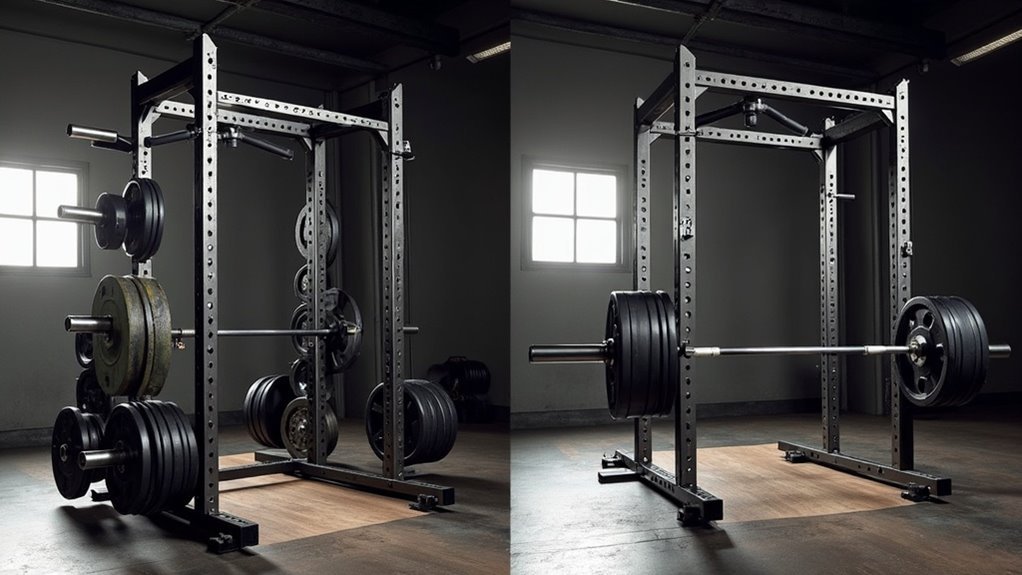
Power racks and half racks are essential pieces of equipment for anyone looking to build a home gym and stay healthy through exercising at home. They differ primarily in their structure and functionality. Power racks feature four vertical posts, offering superior stability and safety for heavy lifting, along with adjustable safety bars to protect you during your workouts. This makes them ideal for serious weightlifters who prioritize safety while performing exercises like squats and bench presses.
On the other hand, half racks have two posts, making them more compact and budget-friendly, which is perfect for those with limited space. Despite their smaller footprint, half racks still allow you to perform essential exercises effectively. If you’re aiming for flexibility and versatility in your home workouts, understanding the unique advantages of both options can help you choose the right equipment to support your fitness journey. Whether you’re a beginner or an experienced lifter, selecting the right rack will enhance your training experience and help you reach your fitness goals from the comfort of your home.
Key Takeaways
- Power racks feature four vertical posts for enhanced stability, making them a great choice for serious lifters, while half racks consist of two posts, offering a more compact design suitable for home gyms with limited space.
- Power racks provide a wider range of exercise options with adjustable safety bars, allowing for a more versatile workout experience, whereas half racks may restrict some exercises due to their reduced stability.
- In terms of pricing, power racks typically range from $300 to $1,000, appealing to those who are serious about their fitness journey, while half racks are more budget-friendly, costing between $150 and $600, making them accessible for home gym beginners.
- Assembling half racks is quicker and simpler, often taking less than an hour, whereas power racks may require a more extended assembly time, which is something to consider for those setting up a home gym.
- Power racks are designed to support heavier weights and create a safer environment for dedicated lifters, while half racks are ideal for those looking to maximize their workout in smaller spaces with basic exercises.
Understanding Power Racks and Half Racks
When it comes to selecting the right equipment for your home gym, understanding the differences between power racks and half racks is crucial for both men and women looking to stay fit and healthy.
Power racks come with four vertical posts, which provide enhanced stability and safety for heavy lifting. This makes them an excellent choice for those who want to perform a wide range of exercises without the need for a spotter, thanks to adjustable safety bars.
On the other hand, half racks feature only two posts, making them more compact and easier to fit into smaller spaces, but they may not offer the same level of security during workouts.
While half racks are often more budget-friendly and quicker to assemble, they generally support lower weight capacities and provide limited versatility for various exercises.
For serious home gym enthusiasts, investing in a power rack is usually the better long-term choice, as it offers the stability and flexibility needed to enhance your fitness journey.
Whether you’re a beginner or a seasoned lifter, the right rack can make a significant difference in achieving your health and fitness goals at home.
Key Advantages of Power Racks
When considering home gym equipment, the advantages of power racks become clear for both men and women looking to enhance their fitness journey.
These sturdy structures provide unparalleled safety features and stability, which are essential for lifting heavier weights during strength training.
- Full enclosure with adjustable safety bars for added security
- Made from durable 11-gauge steel for long-lasting use
- Versatile enough to support a wide range of exercise variations
- A smart long-term investment for committed fitness enthusiasts
Power racks are expertly designed to promote comprehensive strength development, making them perfect for anyone serious about their fitness goals.
Power racks are essential for serious fitness enthusiasts seeking to achieve comprehensive strength development.
While half racks might offer a more budget-friendly alternative, power racks ultimately deliver the reliability and versatility that home gym users need for effective and safe workouts.
Key Advantages of Half Racks
If you’re aiming to enhance your home gym’s efficiency while conserving space, half racks provide numerous advantages that are hard to ignore.
Their compact design occupies minimal floor area, making them an excellent choice for smaller home gym setups. Additionally, half racks are often more budget-friendly than full racks, allowing you to equip your space without breaking the bank.
Despite their smaller footprint, they enable you to perform essential exercises like squats and bench presses, ensuring a versatile workout experience. Many models come equipped with pull-up bars, further increasing their functionality.
Furthermore, assembly and installation are usually quicker and simpler, making them a great option for both beginners and seasoned fitness enthusiasts looking to create an effective workout environment at home.
Comparing Size, Stability, and Versatility
Understanding the differences in size, stability, and versatility between power racks and half racks is essential for making an informed decision for your home gym, whether you’re a seasoned athlete or just starting your fitness journey.
- Power racks provide excellent stability with their robust cage-like structure, making them ideal for intense workouts.
- Half racks are more compact, making them a great choice for those with limited space while still allowing for effective training.
- Power racks typically have a higher weight capacity, catering to serious lifters who want to push their limits.
- Versatility is a strong suit for power racks, as they often come with multiple customization options to enhance your workout experience.
Additionally, power racks excel with safety features like adjustable safety bars, offering crucial protection during heavy lifts.
On the other hand, half racks may limit your exercise range due to their reduced stability and fewer attachment options, so it’s important to consider your fitness goals when choosing the right equipment for your home gym.
Cost Considerations and Assembly Differences
When considering cost and assembly differences for home gym equipment, it’s important to understand the financial implications and time investment associated with power racks and half racks, especially for those looking to enhance their fitness routines at home.
Power racks typically come with a higher price tag, ranging from $300 to $1,000, due to their advanced features, enhanced safety, and superior stability. This makes them an ideal choice for serious lifters who prioritize safety and versatility in their workouts.
On the other hand, half racks are more budget-friendly, often priced between $150 and $600, making them accessible for those who are just starting out or have limited space.
Assembly is another key factor to consider; half racks usually require minimal tools and can be set up in less than an hour, making them a convenient option for home gym enthusiasts.
In contrast, power racks may require two people and take more time to assemble.
Ultimately, the cost difference reflects a long-term investment in safety and versatility, catering to the needs of both beginners and seasoned lifters looking to stay fit and healthy from the comfort of their own homes.