To choose between a full rack and a half rack for your home gym, consider your available space, fitness goals, and budget. Full racks offer enhanced stability and safety for heavy lifting, equipped with multiple attachments, making them ideal for serious lifters who prioritize performance. On the other hand, half racks are more compact and budget-friendly, making them perfect for smaller workout areas while still providing essential functionality. Think about your workout experience and how this investment aligns with your long-term fitness journey. If you need more guidance on making the right choice for your home gym setup, there’s a wealth of information available to help you on your fitness path.
Key Takeaways
- Assess your available space; full racks require larger areas, making them suitable for spacious home gyms, while half racks are designed for tighter spaces, maximizing your workout environment at home.
- Consider your fitness goals; full racks support a wider range of heavy lifting exercises, ideal for serious lifters, while half racks are more budget-friendly for those looking to maintain a basic workout routine.
- Evaluate safety features; full racks offer adjustable safety bars and enhanced stability, making them a great choice for dedicated lifters, while half racks may compromise on security for those focused on lighter workouts.
- Factor in ceiling height; full racks typically need more overhead clearance, so they work best in rooms with high ceilings, while half racks are shorter and fit better in spaces with limited vertical height.
- Analyze your budget; half racks are generally less expensive, allowing you to save on home gym equipment, while full racks are a long-term investment for those committed to serious lifting and fitness goals.
Understanding Full Racks and Half Racks
When it comes to setting up your home gym, understanding the differences between full racks and half racks is essential for effective training, whether you’re a man or a woman.
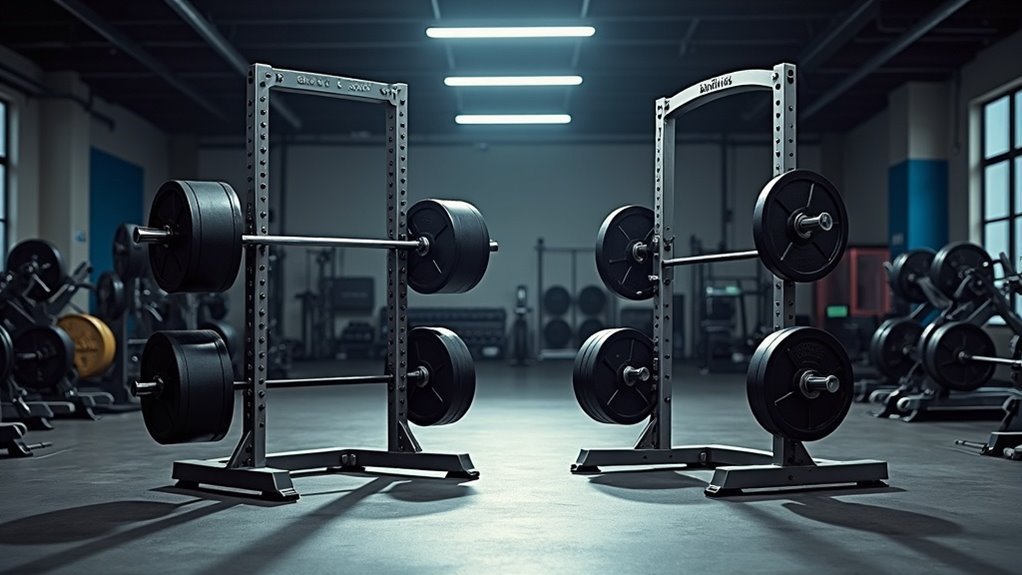
Full racks, also known as power racks, consist of four heavy-gauge steel posts, providing superior stability and safety for heavy lifting exercises like squats and bench presses. They often include adjustable safety bars and various attachments, expanding your exercise options and allowing for a versatile workout routine.
Full racks offer unmatched stability and versatility for heavy lifting, making them essential for a comprehensive workout routine.
On the other hand, half racks feature a compact design with two vertical posts, making them ideal for smaller spaces, although they generally have lower weight capacities.
When selecting the right strength training equipment for your home gym, be sure to consider your available space, budget, and specific training needs to create an effective and enjoyable workout environment.
Key Advantages of Full Racks
While both full racks and half racks are important tools for home strength training, full racks truly excel in providing exceptional stability and safety features.
They’re especially suited for those who lift heavy weights, thanks to adjustable safety bars that help prevent injuries during intense workouts.
- Increased versatility with a wide range of compatible accessories
- Safe solo lifting, minimizing the risk of accidents
- Remarkable durability from robust, heavy-gauge steel construction
Full racks can handle higher weight capacities, making them ideal for serious lifters committed to their fitness goals.
Their enclosed design enhances safety, ensuring your workouts are both effective and secure.
Investing in a full rack is a wise decision for anyone looking to create a well-equipped home gym that promotes health and fitness for both men and women.
Key Advantages of Half Racks
If you’re seeking an effective and space-saving solution for your home gym, half racks provide an impressive combination of efficiency and functionality. Perfect for both men and women, these compact units are budget-friendly and enable you to perform key exercises such as squats and bench presses without the bulk associated with full racks.
| Feature | Half Racks |
|---|---|
| Space Requirement | Compact |
| Price | Generally Lower |
| Versatility | Supports Various Exercises |
| Additional Features | Pull-up Bars, Spotter Arms |
| Assembly Ease | Simple for Beginners |
Investing in a half rack not only maximizes your workout potential but also adapts seamlessly to smaller spaces, making it an ideal choice for anyone looking to enhance their home fitness routine.
Comparing Size and Space Requirements
When selecting between a full rack and a half rack for your home gym, it’s essential to evaluate space efficiency and the differences in floor footprint.
A full rack generally occupies more floor space, making it ideal for larger areas where you have the freedom to move.
On the other hand, a half rack is specifically designed for tighter spaces, perfect for those looking to maximize their home workout environment.
Additionally, don’t forget to consider height, as both options can significantly influence your workout experience at home.
Space Efficiency Analysis
Choosing the right rack for your home gym setup is crucial, especially when working with limited space.
Full racks take up significantly more room due to their four upright posts, making them less ideal for home environments. On the other hand, half racks feature a compact design with just two vertical posts, allowing you to maximize your space while still effectively executing a wide range of exercises.
- Full racks can occupy two to three times more space than half racks.
- Half racks offer an open-sided design, promoting freedom of movement for your workouts.
- Always measure your gym area to ensure safety and adequate clearance around your fitness equipment for optimal exercise routines.
Floor Footprint Differences
Selecting the right rack for your home gym is crucial, especially when considering their floor footprint. A full rack typically requires about 4 feet by 6 feet of space, which may not be ideal for more compact home gyms.
On the other hand, a half rack occupies roughly 3 feet by 4 feet, saving around 50% more space. This smaller footprint allows for greater movement and enhances usability in tighter workout areas, making it suitable for both men and women looking to maximize their home fitness experience.
While full racks do offer added features like adjustable safety bars, they also demand more space. Before making a purchase, be sure to measure your available workout area to ensure you can exercise safely and effectively, as the size and layout of your rack can significantly influence your overall workout experience.
Height Considerations
When planning your home gym, it’s crucial to consider the height of your space, as it greatly influences your decision between a full rack and a half rack.
Full power racks generally range from 72 to 84 inches, requiring significant ceiling height, while half racks are more compact, typically measuring between 70 to 80 inches, making them perfect for smaller areas.
- Full racks provide ample overhead clearance, making them ideal for exercises such as overhead presses.
- Half racks, on the other hand, occupy less space, allowing for a snug fit in tighter environments.
- Always ensure there’s enough space around the equipment for safe movement and exercise execution.
Choose the right option based on the height of your training area and the types of exercises you plan to perform, ensuring a functional and effective workout space for both men and women.
Evaluating Cost and Budget Factors
When evaluating cost and budget factors for your home gym, begin by comparing the initial purchase prices of full and half racks.
While a half rack may be more budget-friendly, it’s essential to consider the long-term investment value of a full rack, especially for serious lifters who prioritize safety and weight capacity.
Additionally, keep in mind any extra equipment costs that may arise depending on your choice, as these can impact your overall budget for creating a functional and effective workout space at home.
Initial Purchase Price
Purchasing a weight rack can significantly impact your home gym budget. Half racks generally cost around $300 less than their full rack counterparts, with prices typically ranging from $200 to $600 for half racks and exceeding $1,000 for full racks.
If you’re looking for an affordable and space-efficient option, a half rack allows you to save money, which you can then invest in additional gym equipment or fitness accessories.
- Assess how often you plan to work out and your specific training needs.
- Consider the initial purchase price in relation to your overall budget for home gym equipment.
- Evaluate the long-term benefits and investment potential of both half and full racks.
Ultimately, your choice should align with your fitness goals and available resources, ensuring you create a home gym that supports your healthy lifestyle.
Long-term Investment Value
When exploring options for your home gym, it’s essential to consider the long-term investment value of a full rack versus a half rack.
While full racks generally come with a higher price tag, often exceeding $300 more than half racks, the latter can be a more budget-friendly choice.
However, if you’re committed to achieving significant fitness goals, a full rack can provide a greater weight capacity and crucial safety features that can elevate your workout experience.
Investing in a full rack could lead to greater long-term benefits, as it supports a wider variety of exercises and the integration of additional accessories.
Keep in mind that choosing a half rack could free up funds for other vital equipment in your home gym, allowing you to maintain a balance between functionality and budget while prioritizing your health and fitness journey.
Additional Equipment Costs
Choosing the right rack for your home gym isn’t just about the initial cost; it’s also about how those costs fit into your overall budget for additional equipment.
Full racks typically come with a higher price tag, which can significantly impact your overall gym setup expenses. Opting for a half rack can help you save money, allowing you to allocate those funds to essential gear that enhances your workout variety and keeps you motivated.
- Consider potential savings for attachments that can expand your exercise options.
- Weigh the durability and versatility of full racks to determine if they meet your fitness needs.
- Assess your long-term investment goals to ensure your setup supports your health and fitness journey.
Investing wisely in your home gym can lead to a more enjoyable and effective workout experience, helping you stay on track with your fitness goals.
Assessing Safety Features and Stability
When considering safety features and stability for your home gym, the distinctions between full racks and half racks can greatly influence your lifting experience.
Full racks provide adjustable safety bars, offering superior protection during heavy lifts, making them ideal for those looking to push their limits safely. In contrast, half racks often utilize spotter arms, which may not provide the same level of security.
Full racks offer adjustable safety bars for optimal protection during heavy lifts, while half racks rely on less secure spotter arms.
The four vertical posts of a full rack enhance overall stability, making it a better choice for those who are lifting substantial weights. This design ensures that you can focus on your workout without worrying about your equipment’s safety.
Furthermore, a well-constructed full rack typically comes with options for floor anchoring, ensuring it remains sturdy and secure during use. On the other hand, half racks may prioritize portability, which could compromise their stability and safety, potentially impacting your lifting confidence.
Whether you’re a seasoned athlete or just starting your fitness journey, investing in the right rack can make a significant difference in your home gym experience.